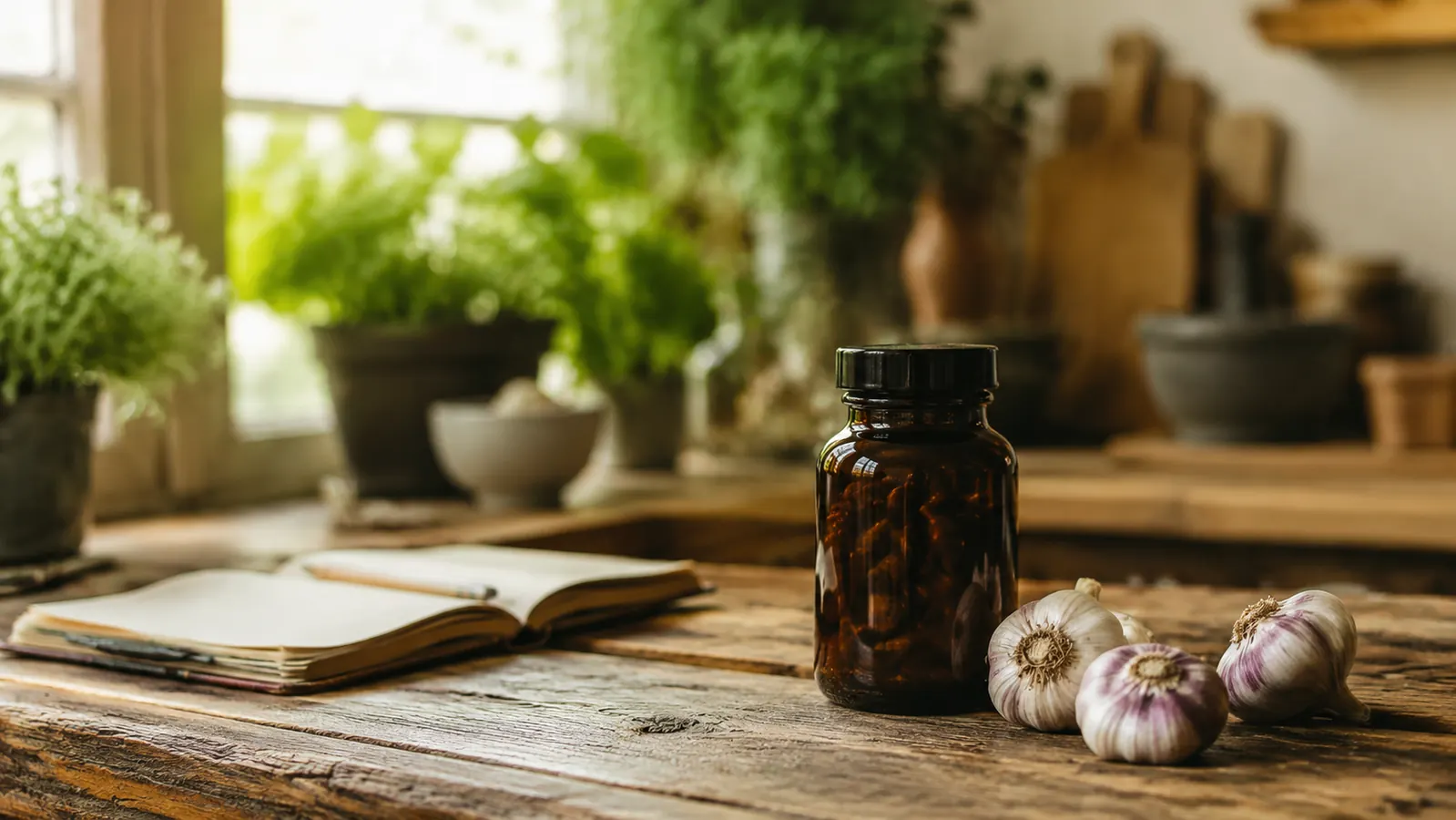
My supplement notebook from October 2024 has a single underlined note on the first page: 'Start Kyolic F100, two capsules with breakfast, track weekly.' Six months later I am still taking it, and that is unusual for me. I finish bottles. I do not always reorder. With Kyolic Formula 100 I have now reordered three times, which is the closest thing to a strong endorsement I know how to give without overstating it.
I want to be clear about what this article is and what it is not. I am not a clinician. I am a label reader who keeps a 90-day supplement journal and reads PubMed abstracts before I commit to a new bottle. I was drawn to Kyolic specifically because most of the published research on aged garlic extract uses either Kyolic-brand material or preparations built to match its specs, which makes comparing the research to the product less of a guess than it usually is. Whether that research translates to measurable benefits for any individual is a different question, one I will try to answer honestly.
A well-researched, genuinely odorless aged garlic capsule with a credible S-allyl cysteine profile, solid for immune and antioxidant support, though it takes patience and people on blood thinners must check with their doctor first.
Amazon See It on Amazon →Still taking it after six months. Here is where to check today's price.
Kyolic Formula 100 comes in 300 capsules, which is a roughly five-month supply at the standard two-capsules-per-day dose. Amazon pricing moves, so check before you buy.
Amazon Check Today's Price on Amazon →How I Have Used It
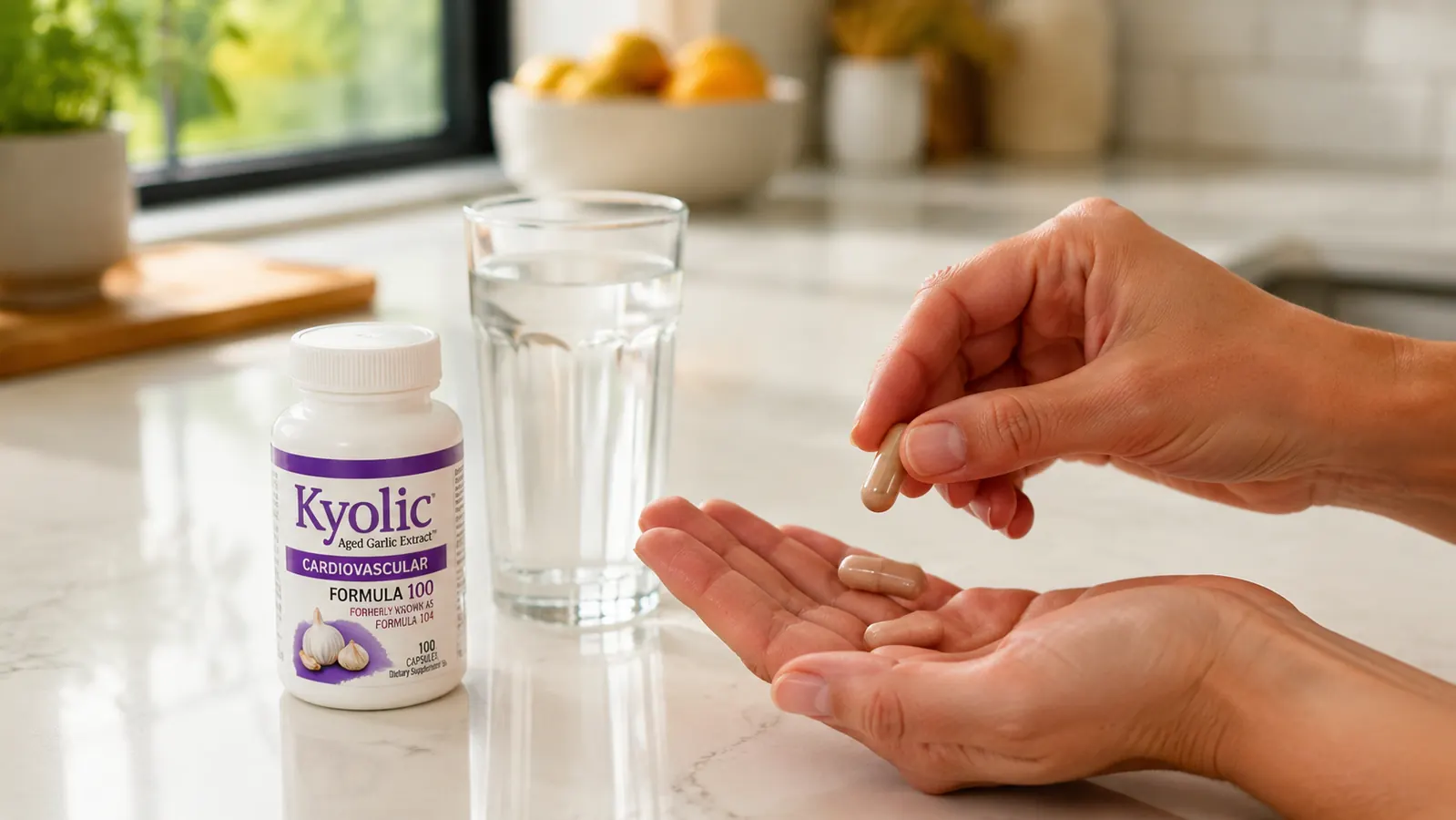
Two 600 mg capsules every morning with the first meal. That is it. I did not stack anything exotic alongside it during the first 90 days because I wanted a clean read on what, if anything, I noticed. My existing daily stack at the time was vitamin D3 (2,000 IU), magnesium glycinate (200 mg), and a B-complex. Nothing that would complicate interpreting the garlic trial.
I kept a weekly entry in my notebook scoring four things on a 1-to-5 scale: energy stability through the afternoon, sleep quality, frequency of minor colds and scratchy throats during the fall and winter season (I live in the upper Midwest, so the window is real), and digestive comfort. I am aware this is not a controlled trial. I am also aware that subjective tracking over time is more honest than most supplement reviewers will admit to using. I will refer to those notes throughout.
By week six I noticed the winter scratchy-throat count was lower than my typical October-through-December average, though I cannot attribute that cleanly to Kyolic. I did not get a formal cold during my first 90-day cycle, which is unusual for me. The second cycle, running through February and March, looked similar. I do not lead with that as proof of anything. I lead with it as context for why I reordered.
The Aging Process and Why It Matters for Odor
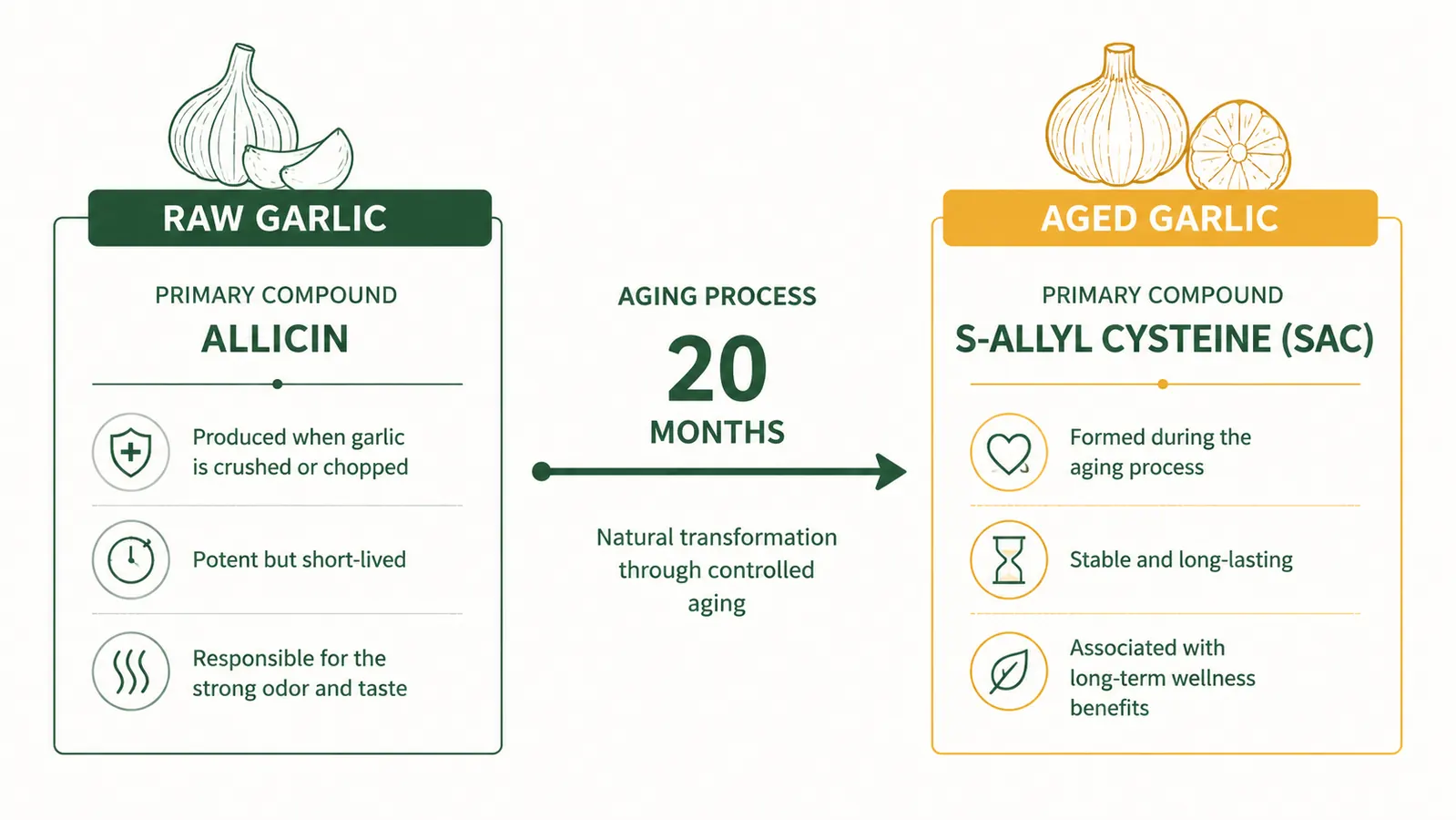
Raw garlic contains alliin and the enzyme alliinase, which combine on contact to produce allicin, the sulfur compound responsible for garlic's sharp smell and most of its antimicrobial reputation. Allicin is also unstable, which is one reason raw garlic supplements vary so much in potency and why garlic breath is inevitable with them.
Kyolic's aging process takes the raw garlic cloves and cold-ages them in an aqueous ethanol solution for up to 20 months. During that time the harsh sulfur compounds, including allicin and its precursors, are converted into a family of stable, water-soluble organosulfur compounds. The most studied of these is S-allyl cysteine, abbreviated as SAC. SAC is odorless. It is also bioavailable in a way that allicin alone is not, with animal and in vitro studies suggesting it is absorbed efficiently and crosses into tissues where antioxidant activity has been observed.
Kyolic does not publish a specific SAC milligram figure on the label, which is a legitimate criticism I will revisit. What they do publish is a standardized extract from 600 mg of fresh garlic equivalent per capsule, with 'aged garlic extract powder' as the active ingredient. The 300-capsule bottle lists no allicin content and no allicin potential, which is accurate, because the aging process specifically depletes allicin in favor of SAC and related compounds. If you are buying garlic specifically for allicin, this is the wrong product.
Immune Support and Antioxidant Activity: What the Research Actually Says
The published literature on aged garlic extract, much of it using Kyolic-sourced material, focuses on a few specific mechanisms. On the immune side, several randomized trials have looked at NK cell activity, meaning natural killer cells, and T-cell proliferation in supplemented adults. A 2016 study published in Clinical Nutrition found that aged garlic extract supplementation was associated with reduced severity and duration of cold and flu symptoms compared to placebo. The proposed mechanism involves SAC's role as a free radical scavenger and its apparent ability to modulate inflammatory signaling pathways. I want to be careful here: these are associations in specific trial populations, not proof that taking two capsules a day will prevent you from getting sick.
On the antioxidant side, SAC has been measured in multiple cell studies as an effective quencher of reactive oxygen species. This is the category where aged garlic extract has the strongest and most consistent research record. The aging process appears to concentrate antioxidant-active compounds that are either absent or unstable in raw garlic. If your interest in garlic supplementation is primarily antioxidant support, aged extract is a more defensible choice than raw garlic powder.
If your interest in garlic supplementation is primarily antioxidant support, aged extract is a more defensible choice than raw garlic powder. The aging process concentrates SAC, which is both stable and bioavailable in a way allicin alone is not.
Does It Actually Have No Odor
This is the part most people want to know and most reviews hedge on. My answer: yes, with one small caveat. The capsules themselves have no detectable garlic smell when you open the bottle, which is the first test. The second test is post-digestion breath, which is the failure mode for every other garlic supplement I have tried. I took Kyolic on an empty stomach once by accident in month two. Faint garlic warmth in my throat for about 20 minutes. Taken with food, as directed, nothing. My partner, who is not a shy critic, has confirmed this on multiple occasions.
The odorless claim holds because of the SAC conversion. Allicin is the volatile compound that produces the sulfurous breath. When you eliminate allicin through the aging process, you eliminate the primary odor pathway. This is not a masking trick with coating or flavoring. It is chemistry.
Label Transparency: What I Wish Were Different
Kyolic Formula 100 lists 'aged garlic extract powder (bulb) (Allium sativum L.)' as the sole active ingredient at 600 mg per capsule. Other ingredients are cellulose capsule shell, cellulose, and silica. Clean label. No fillers I object to. The problem is the absence of a quantified SAC figure. As a label reader I want to see something like 'standardized to X mg S-allyl cysteine per serving.' Kyolic has published SAC content in clinical research papers but does not put the number on the retail bottle. That is frustrating. I understand it may relate to regulatory conservatism, but it makes direct comparison to competing products harder than it needs to be.
The 4.7-star average from over 7,000 Amazon reviews is worth noting here too. A rating that high with that volume of reviews is not driven by people who bought once and forgot about it. The repeat-buyer signal in the review text is strong. That is context, not proof of anything.
Blood-Thinner Interactions: Read This Section
Garlic, including aged garlic extract, has mild antiplatelet and anticoagulant properties. In practical terms this means it may potentiate the effect of blood-thinning medications including warfarin, clopidogrel, and aspirin regimens, as well as NSAIDs. If you are on any of these medications, do not start Kyolic or any garlic supplement without talking to your prescribing physician first. The interaction risk is not theoretical. It has been documented in case reports and is listed in clinical pharmacology references. The same caution applies during pregnancy and in the two weeks before scheduled surgery. I mention this not to scare anyone off but because this is exactly the kind of thing that gets buried in the small print and should not be.
For otherwise healthy adults who are not on anticoagulant therapy, the safety profile of aged garlic extract at standard doses (1,200 mg to 2,400 mg per day of aged extract) is well established in the literature. Side effects in trials have been minimal and primarily gastrointestinal when taken on an empty stomach.
Performance Over Six Months: My Actual Notes
Week 1 through 4: no noticeable change in anything I was tracking. This is normal and I expected it. Garlic supplements are not stimulants. There is no day-one effect. My digestive comfort score was a flat 4 throughout, the same as baseline.
Week 5 through 12 (first 90-day cycle): energy stability scores crept up slightly, from an average of 3.2 in weeks 1-4 to 3.6 in weeks 5-12. I am cautious about interpreting this because the season was shifting from summer heat to fall and my sleep was already improving for unrelated reasons. Immune events: zero colds, two brief scratchy-throat episodes that resolved within 24 hours. This is below my personal historical average for that period.
Week 13 through 26 (second 90-day cycle): I added nothing new to my stack. One minor cold in January, mild, three days. No second cold. Sleep scores remained stable. Digestive comfort never dipped. The one thing I noticed clearly across both cycles was that the supplement is simply easy to take. Two capsules, no smell, no aftertaste, no gastrointestinal drama. That sounds like a low bar. For a garlic supplement, it is not.
Price and Value

At current pricing the 300-capsule bottle works out to roughly a five-month supply at two capsules per day. On a per-serving basis that is competitive with most premium garlic supplements and significantly less expensive than the few that publish verified SAC content. The 300-capsule count also means you are not reordering every six weeks, which reduces the friction that kills most supplement habits.
Pros
- Genuinely odorless in practice, not just on the label
- SAC-rich aging process is backed by the largest body of published research in the aged garlic category
- Clean label with no unnecessary fillers or coatings
- 300 capsules per bottle means fewer reorder cycles
- 4.7 stars across 7,000-plus reviews signals strong repeat-buyer retention
- Well-tolerated at standard doses in healthy adults in trial literature
Cons
- No quantified SAC milligram figure on the retail label, making direct comparison harder
- No allicin content if that is what you specifically want
- Takes four to six weeks before any subjective signal is realistic to expect
- Blood-thinner and anticoagulant interaction requires a doctor conversation first
- Higher per-bottle cost than raw garlic powder capsules, though the formulation difference justifies it
Alternatives I Considered
Before settling on Kyolic Formula 100 I spent time with three other garlic supplements. One was a high-allicin-yield raw garlic powder product. The odor was real, the GI discomfort was real, and I did not finish the bottle. A second was a garlic-and-parsley combo marketed as odor-controlled. It was partially effective on the breath side but the parsley dose struck me as mostly cosmetic and the extract standardization was vague. The third was a competitor's aged garlic product that listed SAC content but had about 40 percent of the review volume of Kyolic, which made the published research harder to cross-reference against the actual product I was taking.
The comparison that matters most to me as a label reader is between Kyolic Formula 100 and a well-standardized allicin-yield garlic supplement. They are different products targeting different mechanisms. Allicin-yield products are for people who want the antimicrobial action of fresh garlic in a pill. Aged garlic extract like Kyolic is for people whose primary interest is antioxidant support, immune modulation research, and long-term daily tolerance without odor or GI issues. Know which goal you are optimizing for before you choose.
Who This Is For
Kyolic Formula 100 makes the most sense for adults who want a daily, long-term antioxidant and immune support supplement, are not on blood-thinning medications, and have had bad experiences with garlic breath or GI upset from other garlic products. It also makes sense for anyone who cares about research traceability, since a meaningful portion of the published aged garlic extract literature uses Kyolic-sourced material. If you read PubMed abstracts before you buy supplements, that provenance matters.
Who Should Skip It
Anyone currently taking warfarin, clopidogrel, or a daily aspirin regimen should not start this without a physician conversation. Anyone in the two weeks before scheduled surgery should hold off. Anyone whose primary garlic interest is allicin content specifically, for antimicrobial or food-safety applications, should look at a different product. And anyone expecting a noticeable short-term effect within the first two weeks should recalibrate their expectations. This is a slow-play supplement, not a stimulant.
Six months in and I am still reordering. Check the current price before the 300-capsule bottle sells down.
Kyolic Formula 100 is the aged garlic extract with the deepest published research record in the category. The 300-capsule count makes it a practical long-term daily supplement without constant reordering. Amazon pricing moves, so the link will always show current price.
Amazon Check Today's Price on Amazon →